

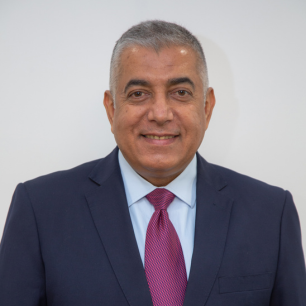
ALI CHAMKHA
Scientific and Technological Achievement -2025
Prof. Ali Chamkha, originally from Beirut, Lebanon, is a globally recognized authority
in Mechanical Engineering, Fluid Dynamics, and Energy Systems. He currently
serves as the Dean of Engineering at Kuwait College of Science and Technology
(KCST). Over a career spanning more than three decades, Prof. Chamkha has
made pioneering contributions to nanofluids, nano-enhanced phase change
materials (NePCM), porous media, filtration, magnetohydrodynamics, multiphase
flow systems, and heat and mass transfer. He earned his Ph.D. in Mechanical
Engineering from Tennessee Technological University (USA) in 1989 and has since
held leading academic and administrative roles across the United States and the
Middle East, including Tennessee Technological University, Kuwait University, and
Prince Mohammad Bin Fahd University in Saudi Arabia, where he served as Dean of
Graduate Studies, Dean of Research, and holder of the Prince Sultan Endowed Chair
for Energy and Environment. Prof. Chamkha has published more than 1,300 peerreviewed
papers, book chapters, and conference articles, which have been cited
over 63,000 times, with a Google Scholar h-index of 143. His innovative research in
nanofluids and phase change materials has opened new frontiers in energy-saving
technologies, particularly for electronics cooling and automotive applications.
His international standing is reflected in repeated recognition by Stanford University
and Elsevier: in 2025, he was ranked #1 in the Arab world and #10 globally in
Mechanical Engineering & Transports, placing him among the world’s top 2% of
scientists across all disciplines. Prof. Chamkha has received numerous awards,
including the Khalifa Award for Distinguished University Professor in Scientific
Research (2011), the Khwarizmi International Award for Engineering (2012), and the
International Obada Prize (2023). A sought-after speaker and prolific editor, he serves
on the boards of multiple high-impact journals and is deeply committed to mentoring
the next generation of engineers, advancing sustainability, and fostering international
collaboration in science and technology.