

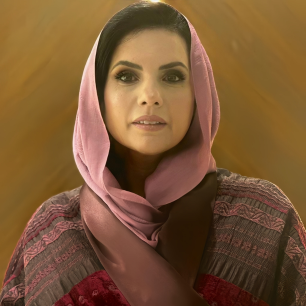
ZAHRA’ LANGHI
Humanitarian and Civic Excellence – 2025
Zahra’ Langhi is a Libyan political strategist, scholar, and UN diplomat whose work
bridges peacebuilding, human rights, women’s leadership, and spirituality.
A global expert in mediation and the Women, Peace and Security (WPS) agenda,
she authored the Strategy and Executive Action Plan of the Arab Network of Women
Mediators, unanimously adopted by the League of Arab States in 2020 and designed
the Strategic Framework for the Protection of Women During Armed Conflict, both of
which remain landmark instruments advancing Arab commitments to gender equality
and peace. Rooted in a powerful family legacy of resistance, Zahra’ descends from
Yousef Langhi, a Libyan nationalist exiled for opposing Italian colonization who later
funded the first Libyan delegation to the UN securing Libya’s independence and led
the reconstruction of Benghazi, and Mansour El-Kikhia, a former Foreign Minister and
UN Representative forcibly disappeared for defending human rights. During Libya’s
2011 revolution, she co-founded the Libyan Women’s Platform for Peace (LWPP),
securing 16.5% representation for women in the country’s first elections and laying
the groundwork for women’s political empowerment. The 2014 assassination of her
friend and colleague Salwa Bughaigis galvanized her global advocacy for justice and
the protection of women human rights defenders. Over the past 15 years, Zahra’ has
played a central role in Libya’s peace processes, including as a member of the UNfacilitated
Libyan Political Dialogue Forum, championing transparency, rule of law,
and inclusive governance
Regionally, she has led innovative peace initiatives in Yemen and forged alliances with
Al-Azhar and Al-Zaytuna universities to counter religious extremism. Recognized by
The Guardian as one of “Seven Women to Watch in Global Politics” and honored
by the Rockefeller Foundation and ATHENA40, Zahra’ has also shared her vision
through her TED and TEDx talks. Today, as a UN diplomat specializing in mediation
and inclusive peace processes, she continues to bridge scholarship, activism, and
policy, advancing a vision of peace rooted in justice, empathy, inclusion, and the full,
equal, meaningful, and safe participation of women in shaping the future.